
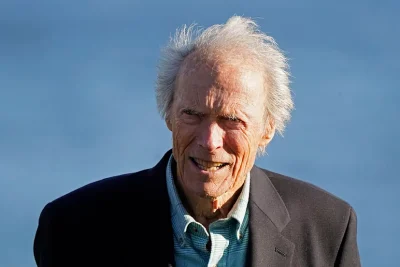
Clint Eastwood is an iconic American actor, director, producer, and composer. In this detailed piece, let’s discuss n, early years, career, personal life. awards and achievements.
Clint Eastwood Net Worth
| Nickname: | Clint Eastwood |
| Real Name: | Clinton Eastwood Jr. |
| Net Worth: | $375 million |
| Birthplace: | San Francisco, California |
| Weight: | 82 kg |
| Sexual Orientation: | Straight |
| Marital Status: | Divorced |
| Spouse: | Maggie Johnson (1953–1984), Dina Eastwood (1996–2014) |
| Children: | Laurie, Kimber, Kyle, Alison, Scott, Kathryn, Francesca, Morgan |
| Girlfriend: | Christina Sandera |
| Date of Birth: | May 31, 1930 |
| Gender: | Male |
| Height: | 1.93 m |
| Profession: | Actor, Director, Producer, Composer |
| Nationality: | American |
| Source of Wealth: | Film, Television, Music |
| Education: | Technical High School, Los Angeles City College |
| Father: | Clinton Eastwood Sr. |
| Mother: | Ruth Wood |
| Brother: | None |
| Sister: | Jeanne Bernhardt |
Early Years
Clinton Eastwood Jr. was born on May 31, 1930, in San Francisco, California. He grew up in Piedmont, California, with his parents, Ruth and Clint Eastwood Sr. He attended Oakland Technical High School and worked various jobs before pursuing a career in acting.
Career
In May 1954, Clint Eastwood auditioned unsuccessfully for Six Bridges to Cross, but got his first minor role in Revenge of the Creature (1955). He had small roles in several films and TV shows, including Lady Godiva of Coventry, Francis in the Navy, Tarantula, and Law Man (1955). His first TV role came in Allen in Movieland (1955). Despite his development as an actor, Universal terminated his contract in 1955.
Eastwood then joined the Marsh Agency and, with help from Arthur Lubin, landed roles in The First Traveling Saleslady (1956) and Escapade in Japan (1957). He continued to struggle, taking small roles in TV series like West Point and Death Valley Days. In 1958, he played a Navy lieutenant in Navy Log and had notable guest appearances, including a villain in Maverick.
Eastwood’s breakthrough came in 1958 when he was cast as Rowdy Yates in the CBS western series Rawhide. The show was a major success, reaching the top 20 in TV ratings. Despite grueling filming schedules, Eastwood’s performance was sometimes criticized. Rawhide ran until 1965, and during its run, Eastwood made his first attempt at directing.
In 1963, Eastwood was cast in Sergio Leone’s A Fistful of Dollars (1964), marking the beginning of his career in spaghetti westerns. He played the Man with No Name, a morally ambiguous antihero, which contrasted with his previous TV roles. The film was a major success and led to two sequels, for a Few Dollars More (1965) and The Good, the Bad and the Ugly (1966), solidifying his status as a major star.
1968-1972
Eastwood’s success in Italy led to more roles in American films. He starred in Hang ‘Em High (1968) and established his own production company, Malpaso Productions. Hang ‘Em High was a major success, earning Eastwood $400,000 and 25% of its net box office.
Eastwood then starred in Coogan’s Bluff (1968), beginning a long collaboration with director Don Siegel. He also starred in Where Eagles Dare (1968) and the musical Paint Your Wagon (1969). Despite its high budget and production issues, Paint Your Wagon was nominated for a Golden Globe Award for Best Motion Picture – Musical or Comedy.
In 1970, Clint Eastwood starred with Shirley MacLaine in the western “Two Mules for Sister Sara”, directed by Don Siegel. The film featured Eastwood as an American mercenary aiding a prostitute disguised as a nun during the reign of Emperor Maximilian I of Mexico. Despite moderate reviews, it was listed in The New York Times Guide to the Best 1,000 Movies Ever Made. That same year, he starred in “Kelly’s Heroes”, a World War II film about Americans stealing gold from the Nazis, marking his last film not produced by Malpaso Productions. The film received positive reception for its anti-war sentiments.
Eastwood and Siegel then planned “The Beguiled” (1971), about a wounded Union soldier at a Southern girls’ school. Though well-received in France, it flopped financially. In 1971, Eastwood directed his first film, “Play Misty for Me”, about a jazz DJ terrorized by a fan. It received critical acclaim, especially for Eastwood’s directorial skills.”Dirty Harry” (1971) introduced Eastwood’s iconic character, Harry Callahan, a tough cop determined to stop a psychotic killer. The film was a commercial success, despite controversy over its perceived fascism. Eastwood became a top box office star by 1972.
1972-1980
In “Joe Kidd (1972), Eastwood portrayed a character inspired by Reise Lopez Tijerina but received mixed reviews. His directorial debut in the western genre came with “High Plains Drifter” (1973), which was commercially successful despite mixed critical reception. He directed and starred in “Breezy” (1973), which failed commercially but featured Sondra Locke, who became an important figure in his life.
Eastwood continued with “Magnum Force” (1973), a successful sequel to “Dirty Harry”. He starred in the offbeat buddy film “Thunderbolt and Lightfoot” (1974) and directed “The Eiger Sanction” (1975), despite on-set accidents.
“The Outlaw Josey Wales” (1976) was highly acclaimed and commercially successful. Eastwood declined roles in “Apocalypse Now” and “Go Tell the Spartans “To make “The Enforcer” (1976), another successful “Dirty Harry” sequel. He directed and starred in “The Gauntlet” (1977) and had a major hit with the comedy “Every Which Way but Loose” (1978), his most successful film at that time.
In “Escape from Alcatraz” (1979), his last film with Siegel, Eastwood played a real-life escapee. He directed and starred in “Bronco Billy” (1980), which was a commercial disappointment but praised by critics. “Any Which Way You Can” (1980), a sequel to “Every Which Way but Loose”, was a major box office success.
1982-1992
“Honkytonk Man” (1982) and “Firefox” (1982) saw mixed receptions, but “Sudden Impact” (1983) revived the “Dirty Harry” franchise, introducing the famous line, “Go ahead, make my day.” “Tightrope” (1984) and “City Heat” (1984) were successful, with “Pale Rider” (1985) marking a return to the western genre, earning critical acclaim.
Eastwood’s “Heartbreak Ridge” (1986) was a commercial success despite internal conflicts. The final “Dirty Harry” film, “The Dead Pool” (1988), was less successful but well-received. He directed the biopic “Bird” (1988), winning two Golden Globes, though it failed commercially. “Pink Cadillac” (1989) was both a critical and commercial failure.
In 1990, Clint Eastwood directed and starred in “White Hunter Black Heart,” an adaptation of Peter Viertel’s roman à clef about John Huston and the making of “The African Queen.” Filmed in Zimbabwe, the movie garnered critical attention but only achieved limited box office success, earning $8.4 million. Later that year, Eastwood directed and co-starred with Charlie Sheen in “The Rookie,” a buddy cop action film praised for its action sequences but criticized for its plot and characterization. An ongoing lawsuit in 1991, regarding an alleged car-ramming incident, prevented any Eastwood films from being shown in cinemas that year, though Eastwood eventually won the case.
In 1992, Eastwood revisited the Western genre with “Unforgiven,” a film he directed and starred in as an aging ex-gunfighter. This film, which had been in development since 1976, was a major success, both commercially and critically, earning nine Academy Award nominations and winning four, including Best Picture and Best Director for Eastwood.
1993-2006
Eastwood continued his streak with “In the Line of Fire” (1993), playing a Secret Service agent haunted by his failure to save JFK. The film was a box office hit, earning $102 million in the U.S., and Eastwood was once again a top-earning star. That same year, he directed and co-starred with Kevin Costner in “A Perfect World,” considered by some critics to be one of his most underrated directorial achievements.
In 1995, Eastwood expanded his acting range by starring opposite Meryl Streep in “The Bridges of Madison County,” which was both a critical and commercial success. He also directed the political thriller “Absolute Power” (1997), and “Midnight in the Garden of Good and Evil,” both receiving mixed reviews.
Eastwood’s directorial efforts in the late 1990s included “True Crime” (1999), a box office disappointment, and “Space Cowboys” (2000), which was better received and grossed over $90 million in the U.S. His next project, “Blood Work” (2002), was less successful, both commercially and critically.
In 2003, Eastwood directed and scored “Mystic River,” which won two Academy Awards and grossed $90 million domestically. He followed this with “Million Dollar Baby” (2004), which won four Academy Awards, including Best Picture and Best Director.
Eastwood directed two films about the Battle of Iwo Jima in 2006: “Flags of Our Fathers” and “Letters from Iwo Jima,” the latter being the first American film to depict the war from the enemy’s perspective and earning critical acclaim.
2008-present
In 2008, Eastwood directed “Changeling,” starring Angelina Jolie, and ended a brief acting hiatus with “Gran Torino,” which became the highest-grossing film of his career at the time. He continued directing with “Invictus” (2009), starring Morgan Freeman and Matt Damon, and “Hereafter” (2010), which received mixed reviews.
Eastwood directed the biopic “J. Edgar” (2011), with Leonardo DiCaprio in the lead role, and returned to acting with “Trouble with the Curve” (2012). He also narrated a Chrysler commercial during the 2012 Super Bowl, sparking political controversy.
In 2014, Eastwood directed “Jersey Boys” and “American Sniper,” the latter becoming one of his biggest commercial successes. He followed this with “Sully” (2016), starring Tom Hanks, and “The 15:17 to Paris” (2018), which received negative reviews.
Eastwood returned to acting in “The Mule” (2018) and directed “Richard Jewell” (2019), a film about the security guard wrongly accused in the 1996 Olympic bombing. In 2021, he directed and starred in “Cry Macho,” which received mixed reviews.
In 2023, reports emerged that Eastwood would direct and produce “Juror No. 2,” expected to be his final film, with production resuming in November 2023 after a temporary suspension due to the SAG-AFTRA strike.
Other
Clint Eastwood’s early interest in music led him to develop as a boogie-woogie pianist, with ambitions to study music theory after high school. In late 1959, he produced the album “Cowboy Favorites,” which included classics like Bob Wills’s “San Antonio Rose” and Cole Porter’s “Don’t Fence Me In.” Despite promotional efforts, the album did not chart. In 1963, producer Kal Mann advised Eastwood he wouldn’t succeed as a singer. Nevertheless, Eastwood performed at rodeos and fairs with Paul Brinegar and Sheb Wooley, earning significant sums per performance. Although he didn’t achieve major success as a performer, he influenced his son, Kyle, who became a professional jazz bassist and composer. An audiophile, Eastwood has a large collection of LPs, favoring musicians such as Charlie Parker, Thelonious Monk, and Robert Johnson.
Eastwood owns Malpaso Records, which is distributed by Warner Bros. Records. This label has released scores for all his films since “The Bridges of Madison County,” as well as the album “Eastwood after Hours – Live at Carnegie Hall.” He composed scores for films like “Mystic River,” “Million Dollar Baby,” and “Changeling,” and wrote the song for “Gran Torino” and co-wrote “Why Should I Care” recorded by Diana Krall. His music for “Grace Is Gone” earned two Golden Globe nominations and won a Satellite Award for Best Song. “Changeling” also received several score nominations. In 2007, Eastwood received an honorary Doctor of Music degree from Berklee College of Music, describing it as a cherished honor. The scoring stage at Warner Bros. Studios was named the Eastwood Scoring Stage in the 1990s.
Personal Life
Clint Eastwood first to Margaret Neville Johnson from 1953 to 1984. In 1975, Eastwood and actress-director Sondra Locke began living together. Eastwood finally separated with Johnson in 1984.
He married news anchor Dina Ruiz in 1996 before divorcing in 2014. His relationships overlapped, resulting in eight known children by six women. The exact number remains a mystery, as Eastwood refuses to confirm it.
His long-term partner, Sondra Locke, filed a palimony lawsuit after their separation saying that Eastwood had physically and emotionally abused her.
Eastwood began dating his current partner Christina Sandera from 2015.
Awards and Honors
Clint Eastwood has received numerous awards and nominations for his work, including: 4 Oscar Awards, 4 Golden Globe Awards and 2 Directors Guild of America Awards.
On August 22, 1984, Clint Eastwood recorded his hand and footprints in cement during a ceremony at Grauman’s Chinese Theatre. In May 1994, he received France’s medal of Commandeur de L’Ordre des Arts et des Lettres at the Cannes Film Festival, where Jeanne Moreau praised his commitment to European cinema. Eastwood won the AFI Life Achievement Award in 1996 and an honorary degree from AFI in 2009. He is one of only two people to be nominated twice for Best Actor and Best Director for the same films (“Unforgiven” and “Million Dollar Baby”), alongside Warren Beatty. At age 74, he became the oldest recipient of the Academy Award for Best Director and has directed five actors in Academy Award-winning performances.
Honors
Despite joking in the 1970s that he would never win an Oscar, Eastwood received numerous other accolades, including a Kennedy Center Honor in 2000, and honorary degrees from the University of the Pacific and the University of Southern California. He received the Irving G. Thalberg Memorial Award in 1995 and a Grammy nomination in 2006. In 2007, Eastwood received the first Jack Valenti Humanitarian Award from the MPAA for his work on “Flags of Our Fathers” and “Letters from Iwo Jima.” He was inducted into the California Hall of Fame in 2006 and awarded France’s Légion de honneur, first in 2007 and then as a Commander in 2009.
Eastwood also received honorary Doctor of Music and Doctor of Humane Letters degrees from Berklee College of Music and the University of Southern California, respectively, in 2007. The National Board of Review of Motion Pictures named him Best Actor for “Gran Torino” in 2008 and Japan awarded him the Order of the Rising Sun in 2009. In October 2009, Lyon, France, honored him with the Lumière Award for his contributions to cinema. President Barack Obama recognized him with an arts and humanities award, praising his films as essays on individuality and American values in February 2010.
Frequently Asked Questions About Clint Eastwood
1. What is Clint Eastwood’s net worth?
$375 million
2. How old is Clint Eastwood?
94 (born May 31, 1930)
3. Where is Clint Eastwood from?
San Francisco, California, USA
4. What is Clint Eastwood’s occupation?
Actor, director, producer, composer
5. What was Clint Eastwood’s breakthrough role?
“A Fistful of Dollars” (1964)
6. How many Academy Awards has Clint Eastwood won?
4
7. Has Clint Eastwood won any honors for his contributions to film?
Yes, including the American Film Institute’s Life Achievement Award and the Kennedy Center Honor
8. Did Clint Eastwood marry?
Yes, twice (Maggie Johnson and Dina Ruiz)
9. How many children does Clint Eastwood have?
8
10. Is Clint Eastwood a musician?
Yes, he has composed music for several films.